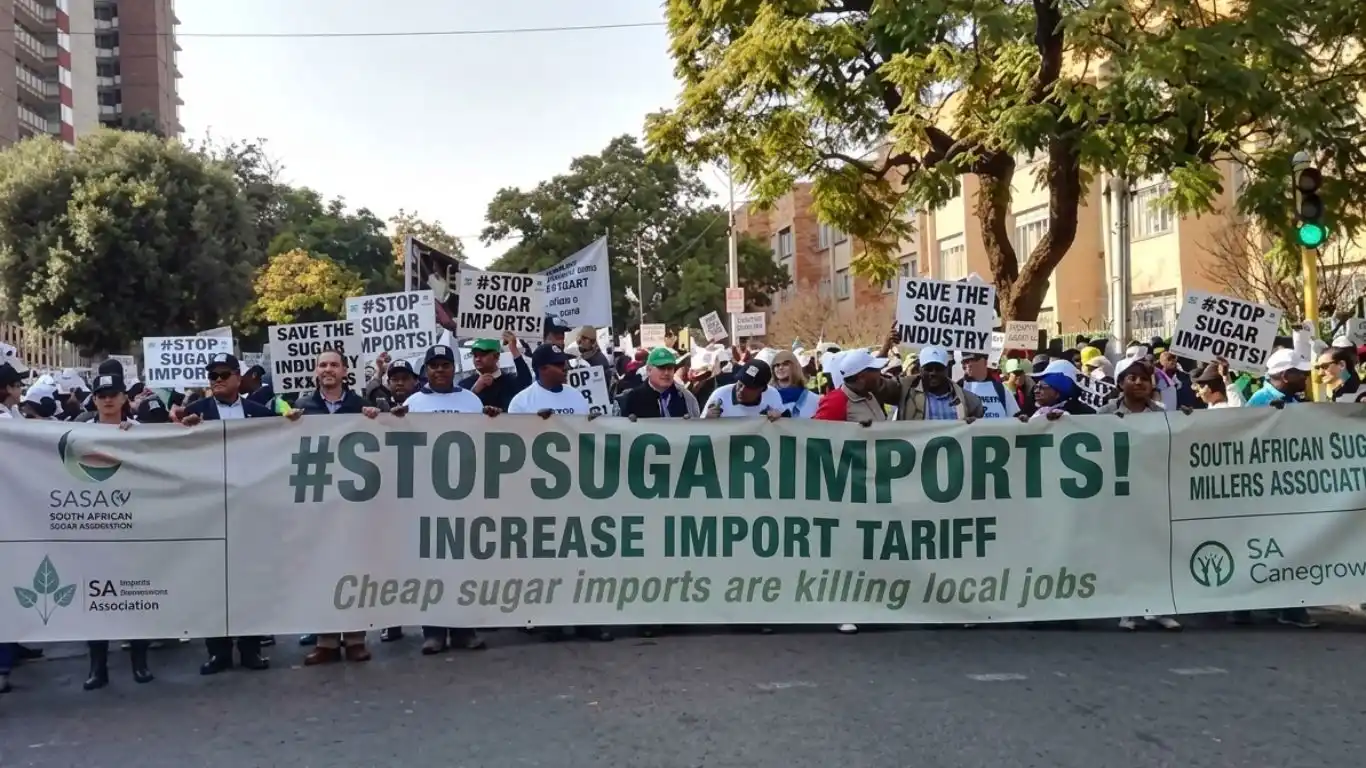
In an unprecedented move, hundreds of sugarcane farmers (growers) from KwaZulu-Natal and Mpumalanga will march to the Department of Trade and Industry (the DTI) tomorrow (26 June 2018) in Tshwane voicing their grave concerns about the grossly insufficient tariff which threatens job losses and puts the sustainability of the sugar industry at risk! At least 1 600 growers and industry leaders will take part in the peaceful march. The country’s sugar industry, which is represented by the South African Sugar Association (SASA), is on a brink of collapse due to the influx of imports as a result of low duty which currently stands at $566 per ton. This has resulted in a big loss of local South African market share. Approximately 25% of the total market has been overtaken by foreign sugar, and the industry revenue has declined by R2.3 billion. This is akin to exporting jobs to other countries. If this crisis is not arrested soon, the industry could collapse, leading to job losses in an industry that currently employs 85 000 with one million people dependent on the cane growing and milling activities of the industry. Therefore, SASA has asked the government for urgent intervention in the form of increasing the reference price (tariff) to an adequate level of $856 per ton. Details of the march are as follows: Date: 26 June 2018 Starting Point: Pretoria Art Museum (on Park Street) at 10am End Point: the dti Campus (in Meintjies Street) at 12.30pm ISSUED BY SASA EXTERNAL AFFAIRS DIVISION To RSVP or for media enquiries, please contact: CEDRIC MBOYISA SASA Communications and Media Manager Cellphone: 083 992 5100 Landline: 031 508 7023 E-mail: Cedric.Mboyisa@sasa.org.za Download Statement FAQ Why did South African sugarcane growers march to the Department of Trade and Industry? Sugarcane growers marched to raise concerns about the impact of increased sugar imports and what SASA described as an insufficient import tariff, which was putting local market share, industry revenue and jobs under pressure. How were sugar imports affecting the South African sugar industry? According to SASA, imported sugar had taken approximately 25% of the local market at the time, contributing to an estimated R2.3 billion decline in industry revenue. What action was SASA asking the government to take? SASA called for government intervention by increasing the sugar reference price used for calculating import duties from $566 per ton to $856 per ton to provide greater protection for the local industry.
In an unprecedented move, hundreds of sugarcane farmers (growers) from KwaZulu-Natal and Mpumalanga will march to the Department of Trade and Industry (the DTI) tomorrow (26 June 2018) in Tshwane voicing their grave concerns about the grossly insufficient tariff which threatens job losses and puts the sustainability of the sugar industry at risk! At least 1 600 growers and industry leaders will take part in the peaceful march. The country’s sugar industry, which is represented by the South African Sugar Association (SASA), is on a brink of collapse due to the influx of imports as a result of low duty which currently stands at $566 per ton. This has resulted in a big loss of local South African market share. Approximately 25% of the total market has been overtaken by foreign sugar, and the industry revenue has declined by R2.3 billion. This is akin to exporting jobs to other countries. If this crisis is not arrested soon, the industry could collapse, leading to job losses in an industry that currently employs 85 000 with one million people dependent on the cane growing and milling activities of the industry. Therefore, SASA has asked the government for urgent intervention in the form of increasing the reference price (tariff) to an adequate level of $856 per ton.
Details of the march are as follows:
Date: 26 June 2018 Starting Point: Pretoria Art Museum (on Park Street) at 10am End Point: the dti Campus (in Meintjies Street) at 12.30pm
Why did South African sugarcane growers march to the Department of Trade and Industry?
Sugarcane growers marched to raise concerns about the impact of increased sugar imports and what SASA described as an insufficient import tariff, which was putting local market share, industry revenue and jobs under pressure.
How were sugar imports affecting the South African sugar industry?
According to SASA, imported sugar had taken approximately 25% of the local market at the time, contributing to an estimated R2.3 billion decline in industry revenue.
What action was SASA asking the government to take?
SASA called for government intervention by increasing the sugar reference price used for calculating import duties from $566 per ton to $856 per ton to provide greater protection for the local industry.
To provide the best experiences, we use technologies like cookies to store and/or access device information. Consenting to these technologies will allow us to process data such as browsing behavior or unique IDs on this site. Not consenting or withdrawing consent, may adversely affect certain features and functions.
Functional
Always active
The technical storage or access is strictly necessary for the legitimate purpose of enabling the use of a specific service explicitly requested by the subscriber or user, or for the sole purpose of carrying out the transmission of a communication over an electronic communications network.
Preferences
The technical storage or access is necessary for the legitimate purpose of storing preferences that are not requested by the subscriber or user.
Statistics
The technical storage or access that is used exclusively for statistical purposes.The technical storage or access that is used exclusively for anonymous statistical purposes. Without a subpoena, voluntary compliance on the part of your Internet Service Provider, or additional records from a third party, information stored or retrieved for this purpose alone cannot usually be used to identify you.
Marketing
The technical storage or access is required to create user profiles to send advertising, or to track the user on a website or across several websites for similar marketing purposes.